Categories
General

Top Tips to Learn a New Language

Some top tips from tutors associated with NLT

#1 Get exposed to the language

Listen to music, radio, watch TV programmes or Netflix series if they are available, and listen to people speaking. The more you are exposed to the language, the more you will get used to unfamiliar sounds and to particular ways natives have of constructing sentences and expressing their thoughts. Remember that each language has sounds and expressions that have no direct correspondence in English, so pay attention and keep an open mind – embrace the differences.

Portuguese tutor

#2 Build friendships with native speakers

This will keep you motivated, and it is, after all, one of the reasons many people want to learn a new language. Some expressions and words are deeply connected to the culture, so making friends with natives will help you understand them better. Additionally, the locals and natives will also tell you words and expressions that you will not hear in traditional classes!

Arabic tutor

#3 Practise unfamiliar sounds

First try out words, and then simple sentences. Keep practising: at home, while making dinner, at breakfast, in the shower, during your commute, etc. Pay attention to the intonation, and be mindful of your pronunciation, especially at first. If you simply say or read the words with your normal English accent, natives will be tempted to switch to English themselves.  The more you practice, the more natural you will sound to natives.

French and German tutors

#4 Use apps and online language programmes

These can help you stay in touch with the language when you don’t have time for a full class, and help you consolidate what you have learned previously. However, you may find yourself getting stuck at a certain level. This is when you may need regular interactions with either a tutor, or other speakers of a particular language, in order to take your competence to a higher level.

German tutor

#5 Have fun!

Don’t be afraid of making mistakes when you try out using a language! Learning a new language is a process, so while you need to be consistent and practise, you should not expect immediate miracles! Have fun with the language, experiment with it, and stay curious! 

All tutors

Categories
General

UNESCO at 75 – Arabic

Our final destination of our UNESCO tour are the Arabic-speaking countries of Africa and the Middle East. Here, Arabic coffee is an integral part of hospitality and is a symbol of generosity.

The beans are selected carefully and lightly toasted over a fire. They are then ground with a copper pestle and poured into a large copper coffee pot over a fire. Once the coffee is brewed, it is first poured into smaller pots, from which it is then poured into the drinking cups.

As with many other cultures, the most important or oldest guests are served first. Importantly, the cup is only quarter filled. It is generally accepted to drink at least one cup of coffee, but no more than three.

Knowledge and traditions of the practice are passed on within families. At the markets, it is common to see elders accompanied by children, learning how to choose the right coffee beans.

© TCA, 2014

Find out more here: https://ich.unesco.org/en/RL/arabic-coffee-a-symbol-of-generosity-01074

Interested in learning Arabic? Find out more: https://norfolklanguagetutors.co.uk/about-arabic/

Categories
General

UNESCO at 75 – France

This week we travel to the beautiful south of France, to Pays de Grasse, in the Provence-Alpes-Côte d’Azur region.

This part of France has a long history of perfume creation. The practice of plant cultivation and blending scents has been around since at least the 16th century! Over the centuries, the communities of Grasse have developed their unique techniques. It requires a lot of skill and knowledge – from the cultivation of the plants, through the processing of the raw materials, to the blending of extracts to make the perfect perfume.

Not only does it bring the community together, the perfume industry is both an important source of seasonal labour and makes up a large part of the regional artisinal economy. Apprentices learn the art in the local perfumeries and commit to many years of learning to master the craft.

This fragrant practice is an important artisan craft of the southern France, drawing in visitors from all over the world. It was added to the Representative List of the Intangible Cultural Heritage of Humanity in 2018.

© Z.Ali – N.Bédar APVPG/CAPG 2015

Find out more here: https://ich.unesco.org/en/RL/the-skills-related-to-perfume-in-pays-de-grasse-the-cultivation-of-perfume-plants-the-knowledge-and-processing-of-natural-raw-materials-and-the-art-of-perfume-composition-01207

Interested in learning French? Find out more: https://norfolklanguagetutors.co.uk/about-french/

Categories
General

International Day of Sign Languages

Today, we celebrate the International Day of Sign Languages! And so, this blog is about British Sign Language (BSL)!

What are Sign Languages?

They are fully functional languages in their own right! Sign Languages are expressive visual-gestural languages with distinct grammatical rules. They are very different to spoken languages and are not an extension of the local spoken language(s). Instead of speaking to convey meaning, sign languages use handshapes, facial expressions, and body language.

. . . . . . . . . . . . . . . . . . . . . . . . . . .

Example

In English, you would ask: What is your name?

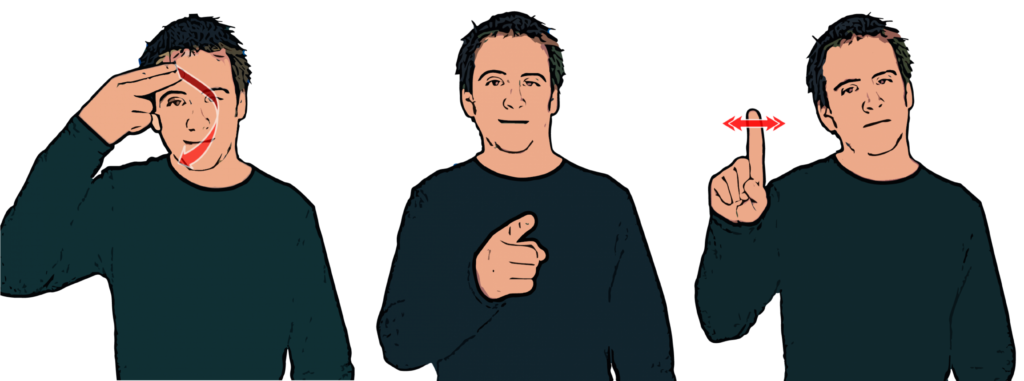
In BSL, you ask: Name + You + What

BSL signs to ask someone what their name is.
How to ask “what is your name?” in BSL: name + you + what
© www.british-sign.co.uk

. . . . . . . . . . . . . . . . . . . . . . . . . . .

Sign Languages are not universal. They evolve wherever there are Deaf people, and they show all the variation you would expect in different spoken languages, including accent and regional variations or dialects. To learn a sign language successfully, you must treat it as though it were a foreign language.

The Deaf community has a very vibrant culture which is quite different from hearing culture!

Where did Sign Languages come from?

Sign Language, in its various forms, has likely been around since before 400 CE (AD 400). St. Augustine (534-430) made reference to the Deaf using signs, as do various Greek and Roman texts. However, there is some evidence that non-verbal communication has been around for much longer.

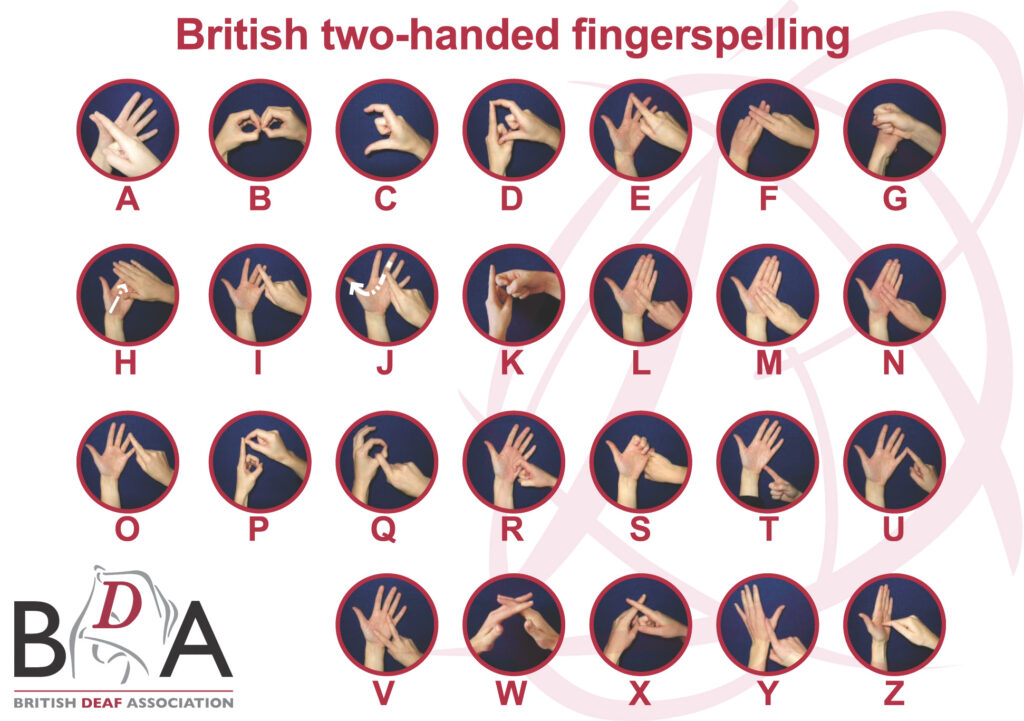
In Britain, the earliest recorded use of Sign Language was in 1576 during a wedding at Leicester Cathedral. The first person to draw some form of sign language handshapes was John Bulwer (1606-1656). Some of those forms are used in the BSL fingerspelling alphabet today!

BSL fingerspelling alphabet.
BSL fingerspelling alphabet
What is BSL and how many people use it?

Sign Language users in the UK use BSL. Over 87 000 Deaf people in the UK use BSL. For many, English is their second language and BSL their main form of communication. BSL was officially recognised as a language in 2003, although it is not yet recognised as an official language of the UK.

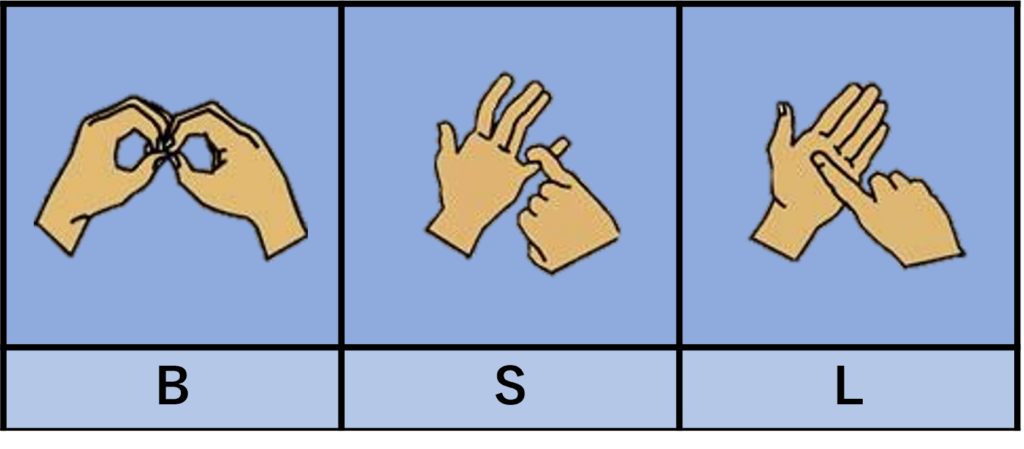
Fingerspelling signs to spell BSL
Why learn BSL?

There are at least 12 million people within the UK that have some form of hearing loss and at least 900 000 of those have severe hearing loss! Therefore, it is quite likely that, at some point in your life, you will encounter someone with a hearing impairment. There are many thousands of hearing BSL users (hearing relatives of deaf people, sign language interpreters or  in other functions within the British Deaf community). At the moment, only about 1 in 150 people in the UK have any knowledge of Sign Language. By learning BSL, you can engage with people with hearing impairments and help to make them feel more included!

Would you like to be one of those people? Take the opportunity to learn some BSL now. You will not regret it!

Interested in learning BSL? Find out more about our tutor here: https://norfolklanguagetutors.co.uk/about-bsl/

Interested in learning more about BSL? Or how to be more Deaf-friendly? Below are links to some informative websites:

UCL History of British Sign Language: https://www.ucl.ac.uk/british-sign-language-history/

Royal National Institute for Deaf People (RNID): https://rnid.org.uk/

British Deaf Association (BDA): https://bda.org.uk/

National Deaf Children’s Society (NDCS): https://www.ndcs.org.uk/

Categories
General

UNESCO at 75 – Croatia

From Asia, we travel back to Europe. Today we visit Croatia. Specifically Sinj, in the south of the country.

In medieval times, there were regular chivalric contests in Croatia’s coastal towns. Sinj now holds the last remaining example of such a competition. Each year, people from Sinj and the surrounding region take part in the Sinjska Alka. In the tournament, knights gallop horses down the main street with their lances aimed at an iron ring hanging on a rope. This ring is called an alka. The word has Turkish roots, which reflects the fact that there was much cultural exchange between these two regions in the past.

Although a competition, the tournament promotes fair play and community participation. It is a community effort to continue the tradition by maintaining and restoring the weapons and clothes. The event also allows the transference of collective memory between generations. This is a very important part of the region’s history, and was recognised as a piece of intangible cultural heritage by UNESCO in 2010.

© UNESCO

Find out more here: https://ich.unesco.org/en/RL/sinjska-alka-a-knights-tournament-in-sinj-00357

Interested in learning Croatian? Find out more: https://norfolklanguagetutors.co.uk/about-croatian/

Categories
General

UNESCO at 75 – Japan

Those of us into stationery will have heard of washi tape: the colourful or patterned rolls of tape which can brighten up journals or wrapped gifts.

What you may not know is that Washi is originally a traditional hand-made paper from Japan. It was named as a piece of Intangible Cultural Heritage in 2014. Washi paper is made from fibres of the paper mulberry plant, which is found in Asia, from India to Japan. There are three communities in Japan that still practice this art. Students of Washi papermaking learn under a Washi master, many of whom learned the techniques from their parents. From students to masters, everyone plays an important role in keeping the craft alive, from looking after the trees to making the paper. It is a symbol of each community’s cultural identity.

But, don’t be deceived by the fact that it is paper. There is so much more to Washi than just use in letters and books. In many Japanese homes, especially the traditional ones, you will find room dividers and sliding doors made from Washi.

© 2013 by Agency for Cultural Affairs

Find out more here: https://ich.unesco.org/en/RL/washi-craftsmanship-of-traditional-japanese-hand-made-paper-01001

Interested in learning Japanese? Find out more: https://norfolklanguagetutors.co.uk/about-japanese/

Categories
General

UNESCO at 75 – Germany

Moving to Germany, we celebrate the tradition of Blaudruck (blueprint/blue-dyeing) (inscribed on the Intangible Cultural Heritage List in 2018). This is the art of printing dye-resistant paste onto fabric before dyeing it indigo-blue. The technique was very common in central Europe during the 18th and 19th centuries.

Nowadays, there are very few businesses engaged in Blaudruck, and those that are, are typically small and family-owned. These workshops are run by anything from second to seventh generation printers! Many still use the traditional hand-crafted printing blocks (Modeln) made over 200 years ago. The patterns often feature local wildlife, culture, or generic patterns.

As with most cultural heritage, the traditional knowledge and techniques are passed on through observation and just getting stuck in. There is a sense of pride in maintaining such a long-lasting family-based tradition.

© Austrian Comission for UNESCO, 2017

Find out more here: https://ich.unesco.org/en/RL/blaudruck-modrotisk-kkfests-modrotla-resist-block-printing-and-indigo-dyeing-in-europe-01365

Interested in learning German? Find out more: https://norfolklanguagetutors.co.uk/about-german/

Categories
General

UNESCO at 75 – Russia

Having listened to the dulcet tones of Fado in intimate surroundings last month, we now turn to the vast expanses of the far eastern regions of the Russian Federation. Here we find the Sakha (Yakutia) Republic, home to the Sakha (Yakut) peoples. What’s that haunting tune you can hear carried on the wind? Hear the epics of the Yakut.

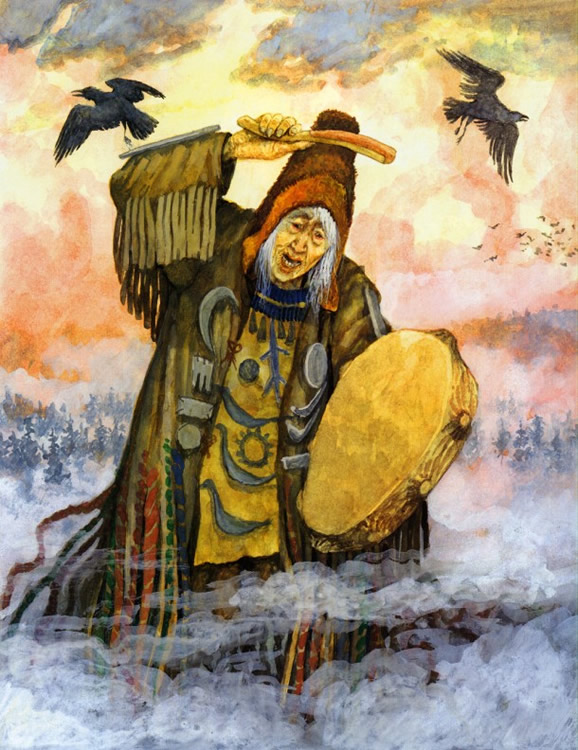
Imagine a small group of people, sat around a fire. Opposite you is an elder recounting a poetic tale through song and verse. This is the Olonhohut – the storyteller. And the poetic tale? An epic.

Olonkho is both a term for the whole Yakut storytelling tradition and the central epic of the Yakut. These epics are poetic tales which can be anything from 10 to 15 000 verses long! The verses alternate between sung and spoken verse, performed by the Olonhohut. Each community has their own narrator, with their own repertoire of improvisations. In this way, there are many different version of the same epic. Each version reflects something of the community and the narrator’s personality and experiences. Traditionally, these stories feature characters from legend: ancient warriors, gods, and animals.

N°00734
© Sakah National Commission for UNESCO

This tradition developed from the family context as a way to entertain and educate, as the stories reflect Yakut beliefs. Since the ‘perestroika’ years of the Soviet Union in the 1980s, interest in Olonkho has increased. However, it is still at risk, as most story-tellers are of the older generations and their numbers continue to decline. (Added to the Intangible Cultural Heritage List in 2008.)

© UNESCO

Find out more here: https://ich.unesco.org/en/RL/olonkho-yakut-heroic-epos-00145

Categories
General

UNESCO at 75 – Portugal

This month we travel the (relatively) short distance from Canary Islands to Portugal. This piece was written by our Portuguese tutor, reflecting on Portuguese culture in Norfolk and the Fado musical form (inscribed on the UNESCO Intangible Cultural Heritage List in 2011).

Saudades de casa – missing home

Like many other of the 400,000 Portuguese immigrants in the UK, I sometimes get a bit nostalgic and miss home. To get a little bit closer to home, one Saturday evening in June I went to see a fado show in Great Yarmouth.

Fado

Fado is a type of music which originated in Portugal in the 1800s. There is a strong emphasis on the voice, which is accompanied by a classic guitar and a Portuguese guitar. No bass, no drums, nothing else. Fado means “fate” or “destiny” . The lyrics often cover the hardships of everyday life in the poor, rural country that Portugal used to be. They can also talk about love, and many songs are about Lisbon or the love of Lisbon! Many songs are sad and nostalgic, expressing a feeling of longing for something lost or unachievable. However, there are also happy, upbeat, and even cheeky fado songs.

There are two mains types, fado de Lisboa (Lisbon fado) which tends to be more upbeat and the fado de Coimbra (Coimbra fado) which tends to be more melancholic. Like all music genres, fado has evolved since its beginnings and the more modern versions make use of other instruments and the lyrics and songs follow different formats.

The Portuguese community

Since life in Portugal was difficult in the 20th century, many Portuguese families have been forced to emigrate, and some settled in the UK. East Anglia has the largest Portuguese community outside London. For example, there are an estimated 10,000 Portuguese in Great Yarmouth. As a result, you can find many restaurants and cafes serving traditional food. Thetford and Norwich also have large Portuguese and afro-descendant Portuguese communities.

Dulce Duca’s fado experience

To celebrate the Portuguese culture, the artist and performer Dulce Duca organised a fado experience evening in Great Yarmouth, with the support of the Out There Arts National Center for Street Arts and Circus. It took place at the Drill House, a beautiful theatre whose ceiling resembles the hull of a ship. The skylights provide an extra touch of ambience, letting you see the night fall around you.

Dulce hosted the show, dressed as a purple cloud and travelling around in roller skates, interacting with the audience. There were two singers, a woman and a man, taking turns singing songs by Amália Rodrigues, Zeca Afonso, Marisa, and traditional songs. One song was accompanied by an aerial hoop act and, during a guitar piece, a young girl performed a tap dance routine. The musicians and singers also invited people from to audience to sing fado with them. The atmosphere was light, spontaneous and playful throughout the evening. As the night fell, the singers alternated between Lisbon and Coimbra fado, finishing with a “desgarrada” – an improvised fado duet.

This magical evening, with songs from my childhood, made me feel happy, like my soul had taken a dive in a mountain pool under a waterfall and was now refreshed and peaceful. Importantly, it made me feel a little bit closer to home.

© 2007 by DUVIDEO Fado Filmes, Zebra Produciones

Find out more here: https://ich.unesco.org/en/RL/fado-urban-popular-song-of-portugal-00563

Interested in learning Portuguese? Find out more: https://norfolklanguagetutors.co.uk/about-portuguese/

Categories
General

UNESCO at 75 – Spain

From the continental climate of Hungary, to the sub-tropical climate of the Spanish Canary Islands, we now visit one of the smaller islands of the Canaries – La Gomera. The hills and isolated rural communities called for a form of long-distance communication. In this way, the whistled language of La Gomera, Silbo Gomero (Gomeran whistle), developed. It has passed down through the centuries, from generation to generation. UNESCO inscribed Silbo Gomero on its Intangible Cultural Heritage List in 2009.

The whistles replicate the spoken language, Castilian Spanish. The language is based on two distinct whistles for the five Spanish vowels and four whistles for consonants. Whistles are distinguised by their pitch and whether the sound is interrupted or continuous. A proficient Silbo Gomero user can convey any message through this technique. The language and ability to use it is a cherished part of the Gomeran culture.

In the second half of the 20th century, fewer people were using the language. In an effor to combat this decline, the language is now taught in schools. Thus, the Silbo Gomero has undergone a resurgence. The majority of the locals understand and use this art to communicate. Whistled languages appear all over the world, including Mexico, Turkey, and the Himalayas. However, Silbo Gomero is one of the few that is fully developed and is still widely used.

© Juan Ramón Hernandez y David Baute. Gouvernement des Canaries, 2008

Find out more here: https://ich.unesco.org/en/RL/whistled-language-of-the-island-of-la-gomera-canary-islands-the-silbo-gomero-00172

Interested in learning Spanish? Find out more: https://norfolklanguagetutors.co.uk/about-spanish/